Astronomy Ph.D. Student at Texas A&M University contact: donofr19@tamu.edu
research
Understanding how galaxies grow and eventually stop forming stars is a central question in galaxy evolution. I use data across multiple wavelengths (primarily radio with ALMA and VLA) to study the fuel that survives in recently quenched, or post-starburst, galaxies. At TAMU I work with Dr. Justin Spilker, and I am a member of the SQuIGGLE collaboration, which studies massive post-starburst galaxies at redshift z ∼ 0.7.
Molecular gas in tidal tails
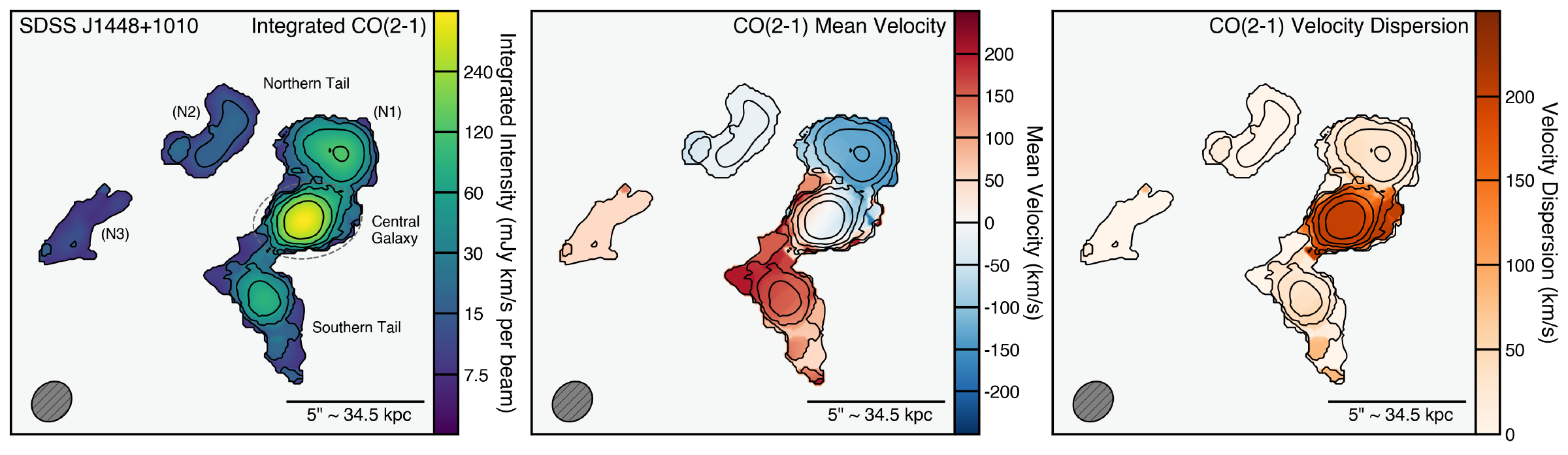
Galaxy mergers can pull gas far beyond the region where most of a galaxy's stars reside. In D'Onofrio et al. (2025), I combined ALMA, Hubble, and VLA observations of two SQuIGGLE post-starbursts to investigate the molecular gas and star formation in their tidal tails. Roughly half of each system's molecular gas lies in these extended structures, which reach up to 65 kiloparsecs from the central galaxy. These observations show that mergers can redistribute a substantial fraction of the fuel during the transition to quiescence. Yet both galaxies retain substantial central reservoirs, leaving an important question: what prevents the remaining gas from efficiently forming stars?
Molecular gas in J1448+1010: integrated CO emission (left), mean velocity (middle), and velocity dispersion (right). Approximately half of the CO emission lies in the tidal tails. From D'Onofrio et al. (2025), reproducing the maps presented by Spilker et al. (2022). Click the figure to enlarge.
The physical state of the surviving gas
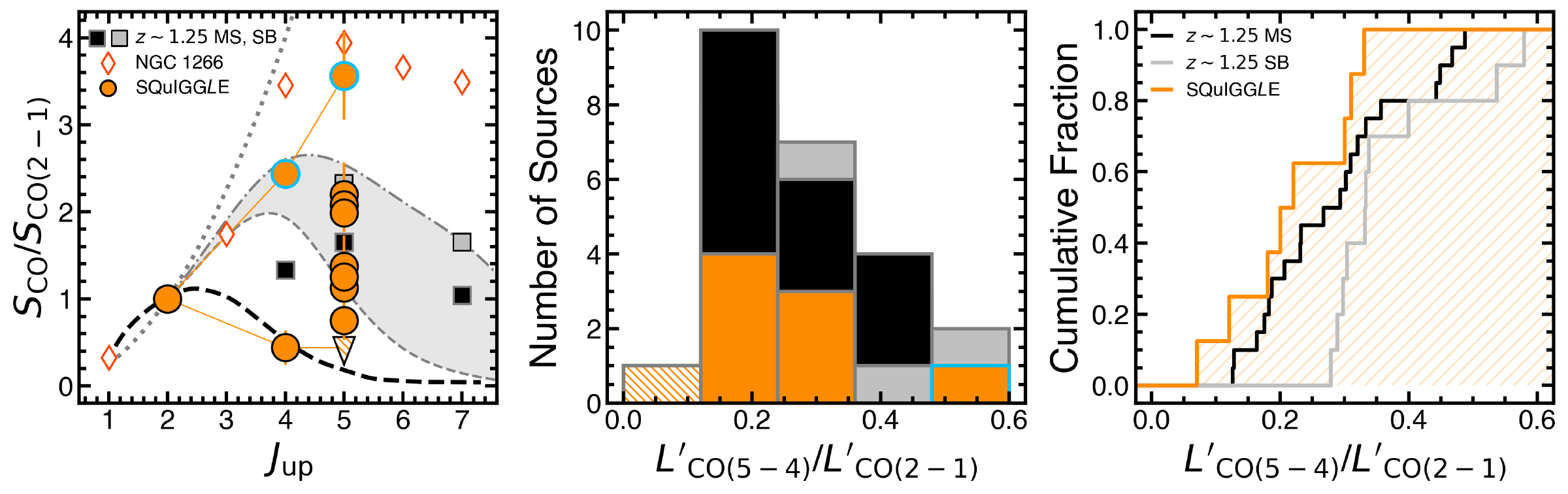
The presence of molecular gas alone does not tell us whether a galaxy will form stars: the conditions within that gas matter. In D'Onofrio et al. (2026), I led an ALMA study of CO excitation in nine gas-rich SQuIGGLE post-starbursts, comparing emission from different rotational transitions to investigate the physical state of their surviving reservoirs. Most systems show moderate excitation, while J1448+1010, which hosts an active galactic nucleus, stands out with much more highly excited gas. Its excitation likely requires an additional source of heating beyond star formation, although obscured star formation may also contribute. These results motivate a closer look at whether the remaining reservoirs contain the dense gas most closely associated with star formation, and how black hole activity may influence those conditions.
CO spectral line energy distributions (left) and excitation ratio distributions (middle and right) from D'Onofrio et al. (2026). SQuIGGLE galaxies are shown in orange; the blue outline marks the highly excited AGN host J1448+1010. Most of the sample has moderate excitation. Click the figure to enlarge.
Ongoing: radio activity, dense gas, and quenching across cosmic time
I am leading a VLA survey of ~50 SQuIGGLE galaxies designed to connect radio activity to the time elapsed since each galaxy's recent burst and to the molecular gas that survives afterward. I have several ongoing ALMA and VLA programs that use complementary views of cold gas and radio emission to determine what regulates this surviving fuel and keeps these galaxies from resuming star formation. Building on the survey, I will use high-resolution, multifrequency VLA observations to distinguish radio emission associated with black hole activity from emission produced by ongoing or recent star formation. In four systems with structures consistent with compact radio lobes, I will also model how the radio spectrum changes as the emitting electrons lose energy, testing whether the currently visible activity accompanied the decline in star formation or began afterward. My complementary ALMA program will measure multiple dense-gas lines in three gas-rich post-starbursts to determine whether their surviving reservoirs lack a substantial dense component or retain dense gas despite suppressed star formation. I am also extending these questions to several spectroscopically confirmed massive quiescent galaxies at z ∼ 3–4.5. By using ALMA to measure, or place stringent limits on, their dust-based gas masses, I will test whether substantial fuel reservoirs can survive the earliest shutdowns of star formation and whether quenching follows similar pathways across cosmic time.
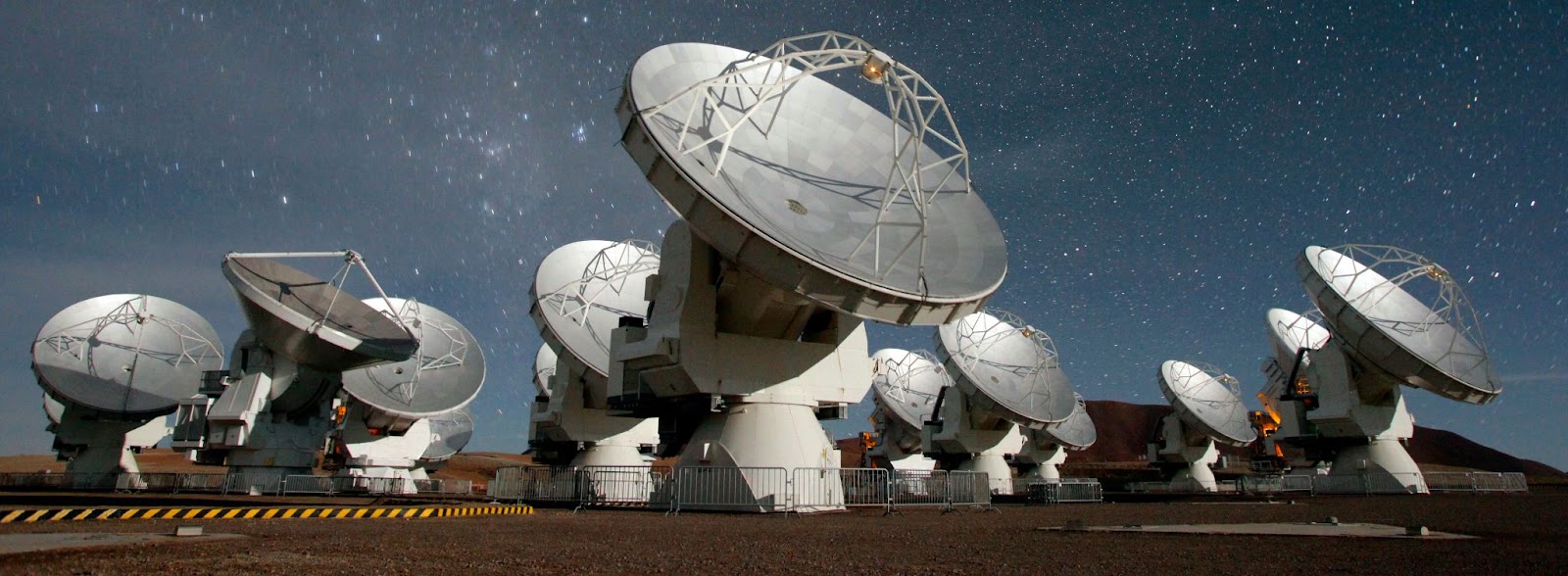
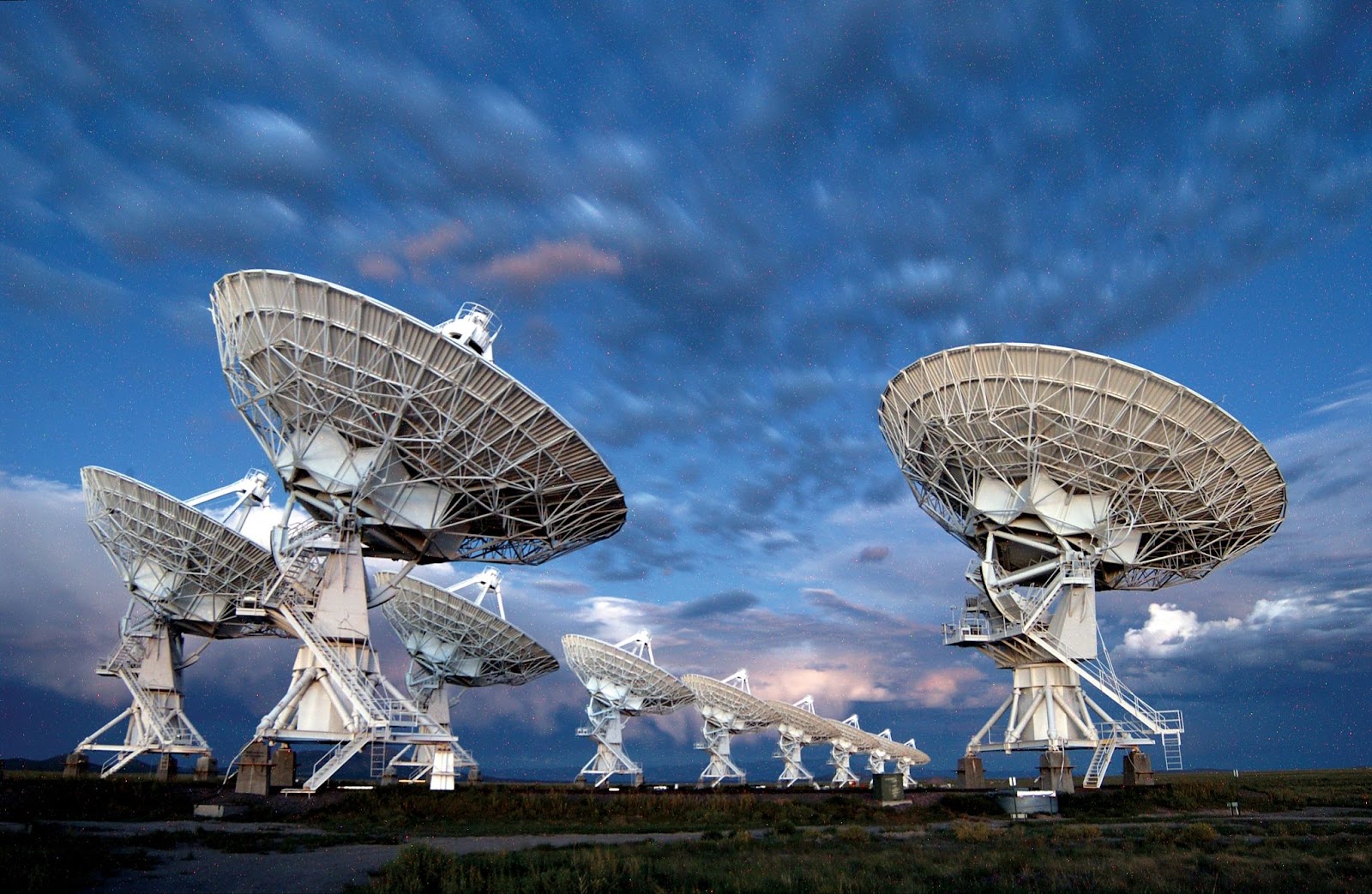
ALMA (left) and the VLA (right), the two observatories central to my research.
outreach
Sharing astronomy and supporting students
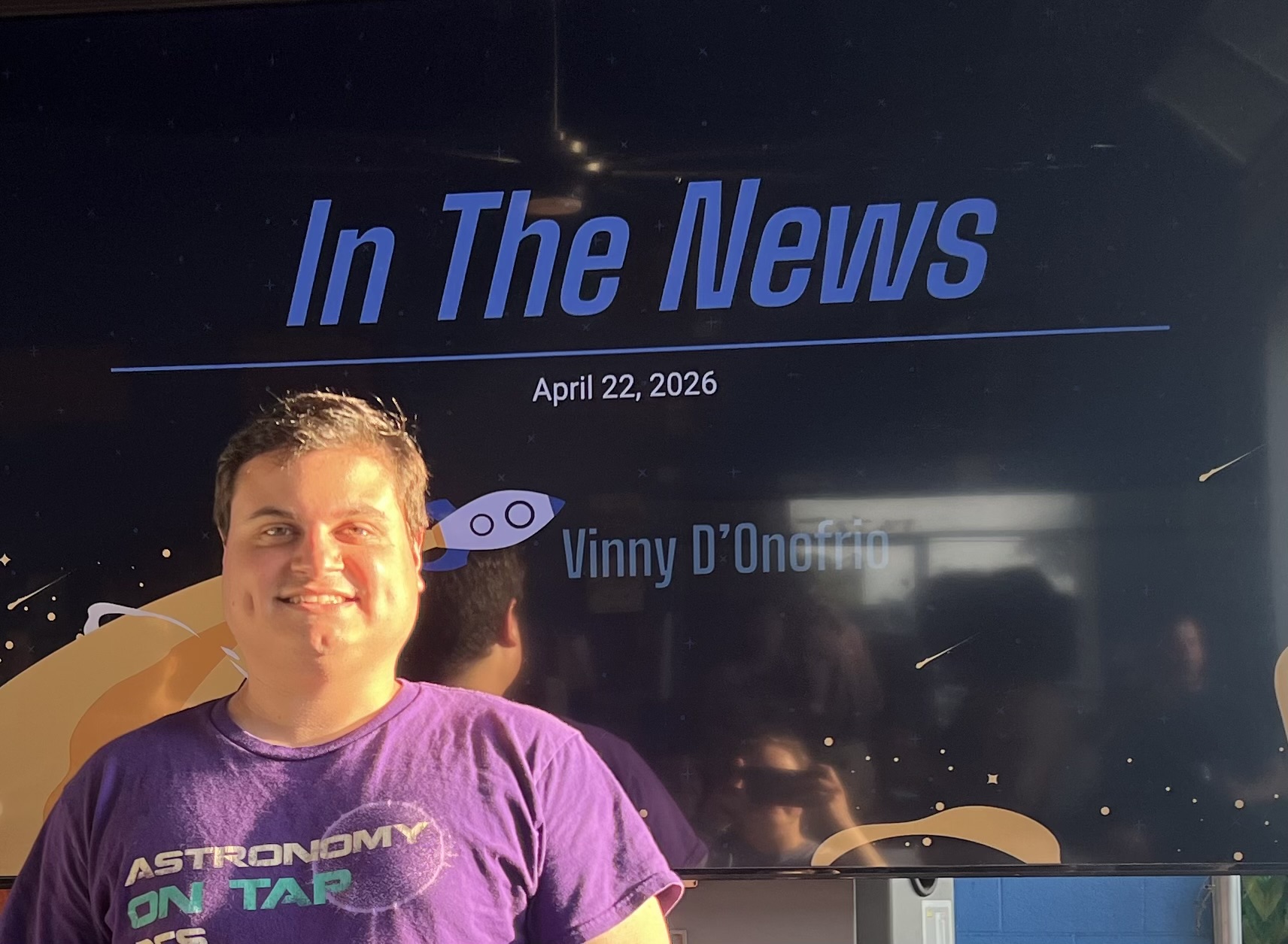
Presenting In the News at Astronomy on Tap.
I enjoy making astronomy accessible to audiences both inside and outside the university setting. At TAMU's monthly Astronomy on Tap events, I served as the In the News presenter, translating recent discoveries for a public audience, and previously created the evening's astronomy trivia. I have also given public talks on topics like the practical challenges of sending people to Mars, and I'm counting down the days to talk about the cosmology of middle earth on Tolkien Reading Day 2027!
Within the Texas A&M Department of Physics and Astronomy, I coordinate MAGIC (Mentoring and Advising Graduates in an Inclusive Community), a graduate student-run program that helps incoming students navigate the transition to graduate school. I also co-led GLASS (Graduates Learning Astro and Soft Skills), which organized practical workshops on research tools, coding, and professional development.
My outreach also connects me directly with younger students. Through Letters to a Pre-Scientist, I serve as a STEM pen pal and help make a career in astronomy feel more tangible. I have also spoken with local high school students about the day-to-day experience of pursuing an astronomy Ph.D. and participated in the Adopt-a-Physicist program.
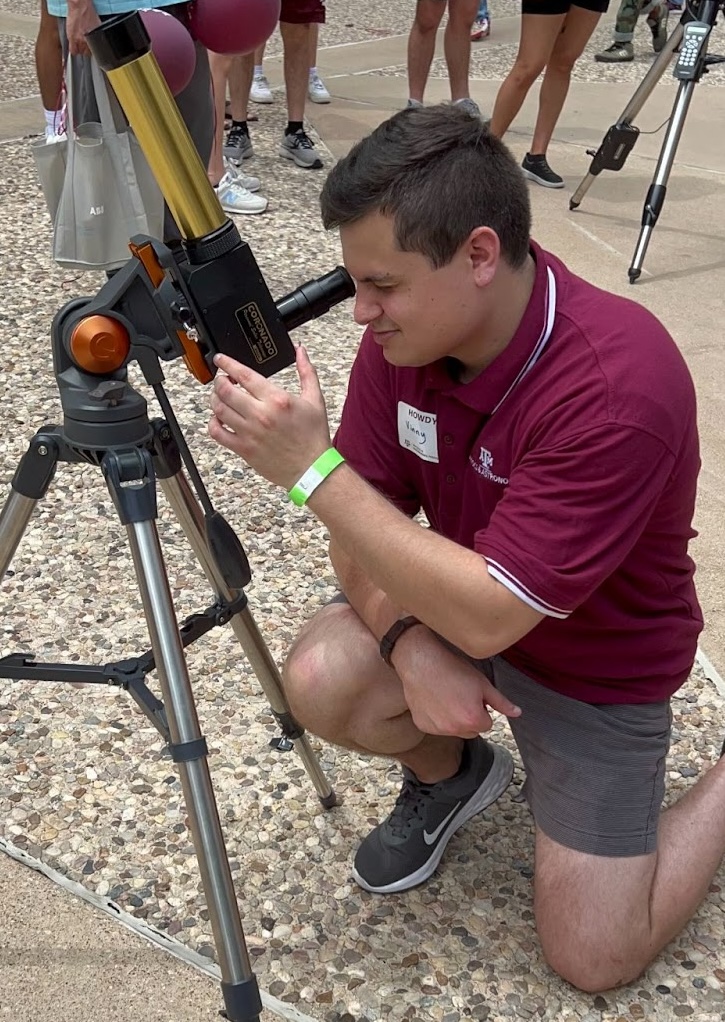
Setting up a solar telescope at the Texas A&M Physics and Engineering Festival.
I also volunteer at the annual Texas A&M Physics and Engineering Festival, where thousands of visitors explore hands-on science demonstrations. One of my favorite roles is helping visitors observe the Sun's chromosphere through an H-alpha telescope... once I manage to get it centered!
About
Hello! I'm Vinny, a fifth-year graduate student in astronomy at Texas A&M University (TAMU). I work with Justin Spilker and the SQuIGGLE colab studying the suppression of star formation, or 'quenching', in higher redshift post-starburst galaxies. My interests in astronomy primarily include galaxy evolution across cosmic time, mainly using data from radio telescopes like ALMA and VLA.
I'm also very active in mentoring and outreach for a variety of audiences, where my goal is to promote astronomy in an inclusive manner. In my free time, I'm a huge Lord of the Rings nerd and Detroit sports fan!
Get in touch at donofr19@tamu.edu!
CV
You can view my CV (last updated October 2026) by clicking the button below.
This is bold and this is strong. This is italic and this is emphasized.
This is superscript text and this is subscript text.
This is underlined and this is code: for (;;) { ... }. Finally, this is a link.
Heading Level 2
Heading Level 3
Heading Level 4
Heading Level 5
Heading Level 6
Blockquote
Fringilla nisl. Donec accumsan interdum nisi, quis tincidunt felis sagittis eget tempus euismod. Vestibulum ante ipsum primis in faucibus vestibulum. Blandit adipiscing eu felis iaculis volutpat ac adipiscing accumsan faucibus. Vestibulum ante ipsum primis in faucibus lorem ipsum dolor sit amet nullam adipiscing eu felis.
Preformatted
i = 0;

while (!deck.isInOrder()) {
    print 'Iteration ' + i;
    deck.shuffle();
    i++;
}

print 'It took ' + i + ' iterations to sort the deck.';